
03:56
Compare the advantages and disadvantages of traditional and Roth IRAs.
Understand the timing and tax implications of Roth IRA conversions and how they may fit into your investment goals.
Explore three Roth conversion scenarios and see how they compare to your goals.
Overview
There are many ways to invest your money to help reach your financial goals. One common retirement investment option is a Roth IRA. This guide explains some of the advantages and disadvantages of Roth IRAs, how Traditional IRA, IRA Rollover or certain qualified plan assets can be converted into Roth IRAs and who might benefit from these types of accounts. Deciding whether a Roth IRA conversion makes financial sense largely depends on your current and future tax rates, time horizon and planned distributions.
Typically, most investors have the option of contributing to a Traditional IRA or a Roth IRA, even if you have an employer-sponsored retirement plan such as a 401(k), 403(b) or 457(b). Most investors also have the option of converting retirement assets into a Roth IRA. Traditional and Roth IRAs each have unique benefits and Internal Revenue Service (IRS) limitations, including contribution and tax deductibility limitations—the key difference is when you pay income taxes.
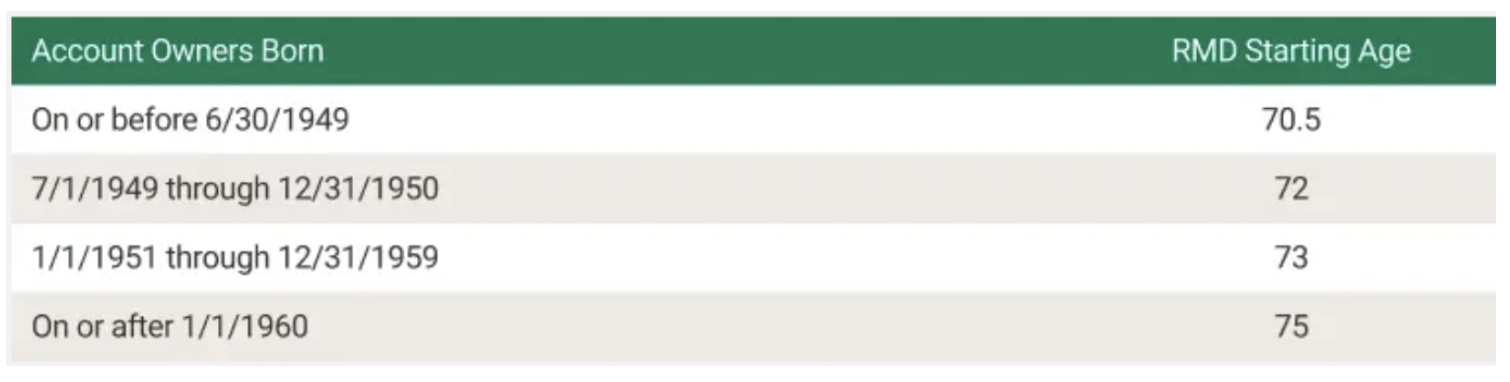
With a Traditional IRA, your contributions are generally tax deductible and grow tax-deferred.* Distributions from a Traditional IRA are taxed as ordinary income, and Required Minimum Distribution (RMD) rules apply once you reach a certain age:
For a Roth IRA, contributions are made with money that has been taxed before going into the account—post-tax dollars. Roth IRA contribution eligibility is dependent on your tax filing status and Modified Adjusted Gross Income (MAGI). Contribution rules based on MAGI can be found in chapter 2 of IRS Publication 590-A. High-income earners are prohibited from contributing to a Roth IRA. *** However, they can utilize what is commonly called a “Backdoor” Roth IRA where they contribute up to the allowable limits to a non-deductible IRA (subject to the IRS’ pro-rata rule**) and convert those funds into a Roth IRA.
*Nondeductible contributions to a Traditional IRA are subject to different rules. Consult your tax advisor for details.
**https://www.irs.gov/pub/irs-pdf/p590a.pdf
***The Pro Rata Rule requires IRA owners to consider all of their Traditional IRAs as the same account. It prevents IRA owners from only converting non-deductible IRAs (after tax) to Roth IRAs and thereby avoiding the taxes that would normally be involved in the conversion process. See IRC Section 408(d)(2).
***https://www.irs.gov/pub/irs-pdf/p590a.pdf

Get the complete guide.